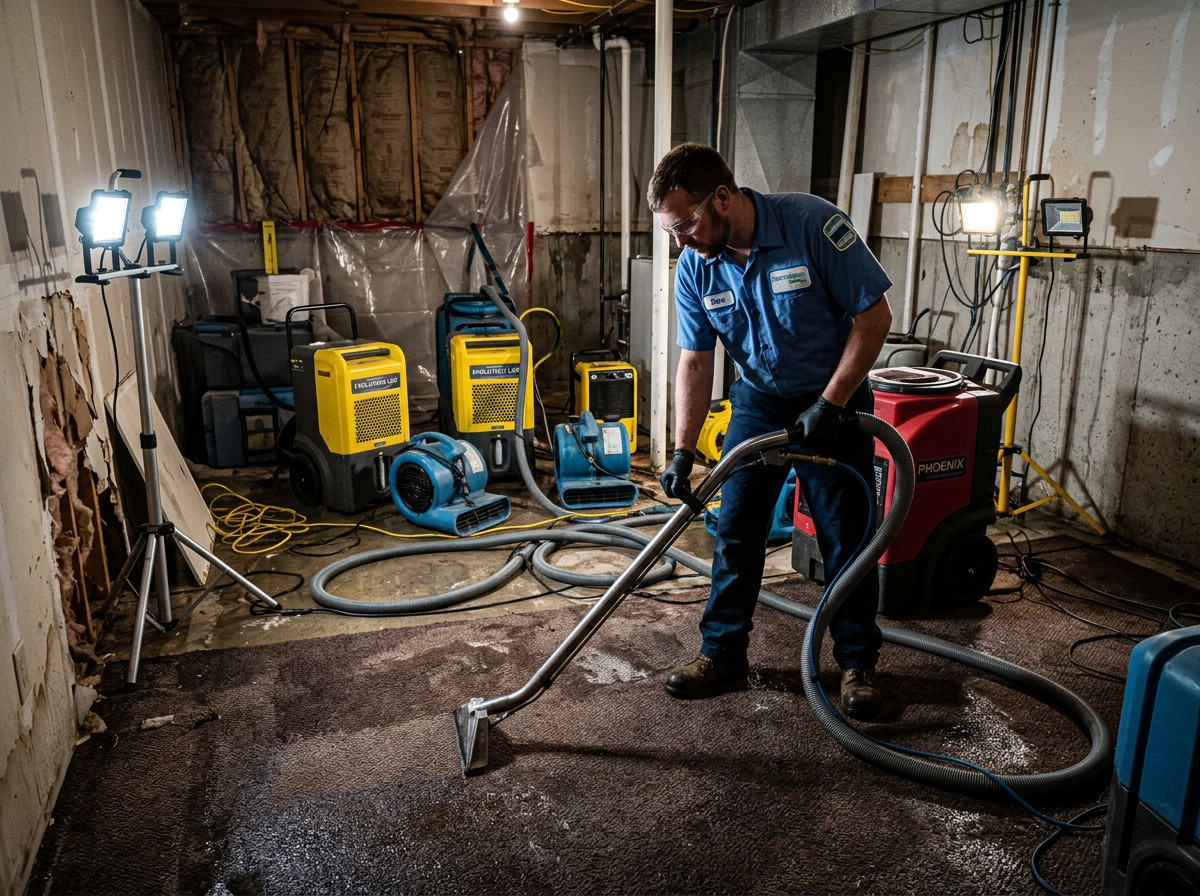
Minnesota basements face three distinct water sources that each demand separate handling. Spring snowmelt over 42-60 inch frost depth sends sheet flow against foundations in March and April. Combined sewers in Minneapolis and Saint Paul cores surcharge and push Category 3 sewage up floor drains. Failed or frozen sump pumps during power outages or ice-blocked discharge lines allow groundwater to rise quickly into finished spaces.
Finished basements with drywall, carpet, and cabinetry rarely survive full saturation. Sheetrock wicks upward from the bottom plate, carpet padding holds contaminated water against subfloors, and particleboard vanities swell beyond recovery. Extraction must precede drying because trapped moisture behind baseboards or under vinyl leads to hidden mold within days once temperatures rise.
Winter drying is slower because outside air cannot be used for ventilation without risking frozen pipes or further heat loss. Technicians place air movers to create directed airflow across wet materials and pair them with low-grain dehumidifiers sized for the volume. Moisture meters track hidden pockets in wall cavities and under slabs; stopping too early leaves residual dampness that reappears after the next freeze-thaw cycle.
Pumping a fully flooded basement too quickly can collapse walls when outside soil remains saturated. Controlled drawdown and temporary shoring protect the foundation while water is removed. Contents that can be salvaged are packed out for off-site drying; porous items exposed to Category 3 water are documented and discarded on site.
Technician insight
In Osseo, the thing that catches most people out with Water Damage Restoration is how quickly finished basements on the Anoka sand plain can appear dry on the surface while clay pockets in Wright County or Hennepin lake-belt homes stay saturated behind baseboards for weeks after the initial event.
Osseo Finished Basement After March Melt
Spring snowmelt entered a 1970s split-level through the rear foundation wall. Water wicked into carpet padding and lower drywall across the recreation room and utility area. Extraction and targeted drying prevented mold growth behind cabinets; only the carpet and bottom two feet of drywall required replacement.
Water Damage Restoration Services We Offer
✓Spring Snowmelt Seepage Response
Addresses sheet flow over frozen ground entering foundations during March and April thaws common across the Hennepin lake belt and Anoka sand plain.
✓Sewer Backup Response
Handles Category 3 water rising through floor drains from surcharged combined sewers in older Minneapolis and Saint Paul neighborhoods.
✓Sump Pump Failure Response
Manages groundwater intrusion after power loss or mechanical failure in homes throughout Osseo and surrounding Wright County clay soils.
✓Frozen Discharge Line Flooding
Removes water that backs up when sump lines freeze solid during prolonged subzero periods typical in Minnesota winters.
✓Finished Basement Restoration
Removes and replaces saturated drywall, carpet, and trim while drying wall cavities and subfloors in finished lower levels.
✓Contents Pack-Out
Documents, removes, and transports salvageable items from flooded basements for controlled drying away from the affected structure.
How it works
- 1
Initial Assessment
Technicians inspect for water source, category, and affected materials while mapping moisture in walls, floors, and cavities.
- 2
Water Extraction
Standing water is removed using pumps and extractors with attention to controlled drawdown to protect foundation walls.
- 3
Drying and Monitoring
Air movers and dehumidifiers are positioned for directed airflow while daily moisture readings guide equipment adjustments.
- 4
Cleaning and Verification
Surfaces are sanitized according to water category and final meter readings confirm dryness before any rebuild begins.
Pricing
Scope depends on water category, depth of saturation, and square footage of finished space. Call for an inspection-based assessment.