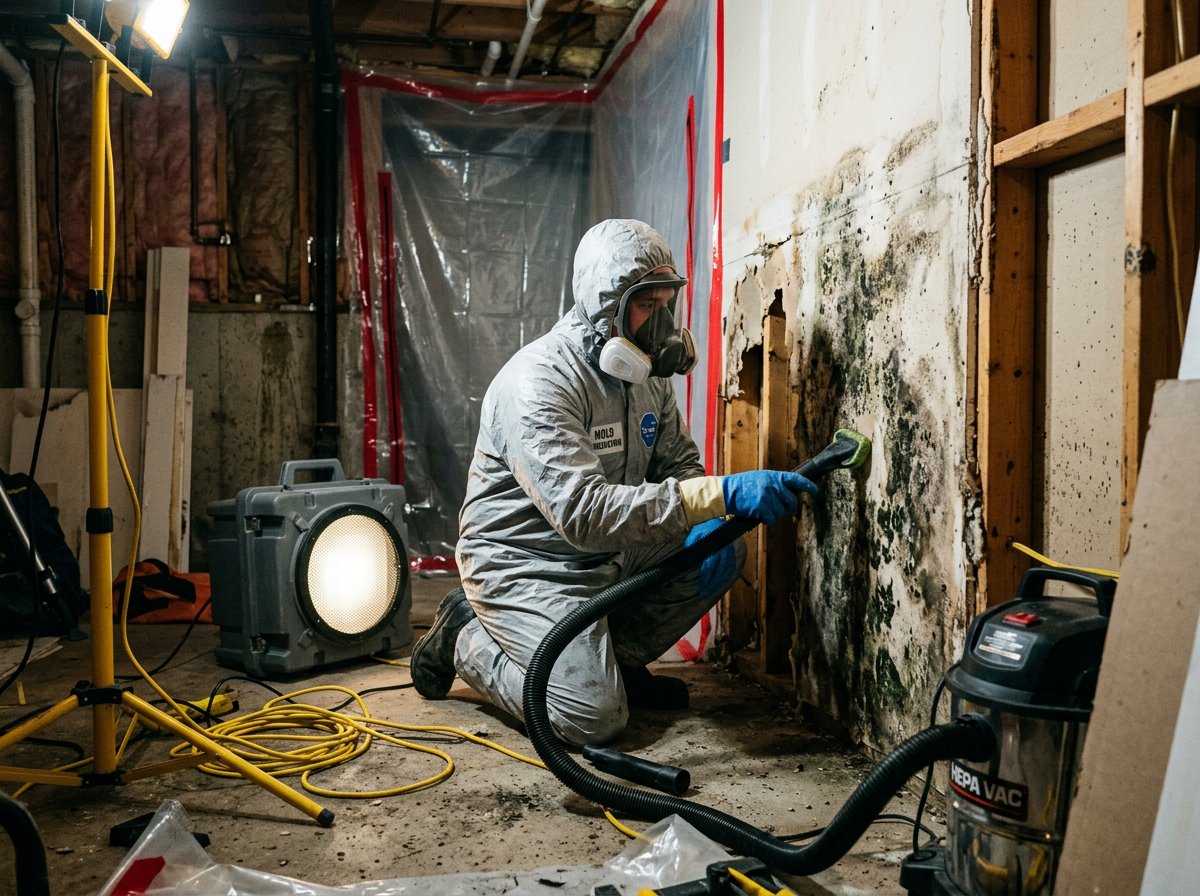
Minnesota basements finished with carpet, drywall, and drop ceilings hide mold growth that starts behind baseboards or in sill plates once spring meltwater or ice-dam leaks push past the 42-60 inch frost line. Water travels along the foundation, so visible spots on lower walls often mean hidden growth in the cavities above. Without locating and stopping the entry point first, any removal work simply returns the following season when Anoka sand drains fast but Hennepin clay holds moisture against the wall.
Technicians build containment with plastic sheeting and negative air machines before disturbing material, then remove affected drywall and insulation in sections rather than whole rooms. Air movers and dehumidifiers stay in place until moisture meters read below 12 percent on wood and concrete, a process slowed in winter because exterior venting is limited. Jobs fail when homeowners treat only the stain or when a sump discharge line remains frozen and reintroduces water.
Post-remediation air sampling confirms clearance, yet the real limit is that finished basements with particleboard subfloors or carpet pad glued directly to concrete often require full replacement rather than cleaning. Sewage backups from combined sewers in older Minneapolis and Saint Paul blocks add Category 3 contamination that forces disposal of porous items immediately.
Technician insight
In Osseo the thing that catches most people out with Mold Remediation is assuming the stain on the drywall is the whole problem when the real source is water sheeting across still-frozen ground in March and entering through the sill plate of a 1970s finished basement on the Anoka sand plain.
Ice Dam Leak into Finished Attic
Spring melt from an ice dam sent water into the ceiling of a 1980s split-level in Osseo. Inspection showed wet insulation and mold on the top plate extending two feet into the wall cavity. Containment was built, affected materials removed, and the roof edge corrected before drying and clearance sampling.
Mold Remediation Services We Offer
✓Containment and Negative Air
Plastic barriers and HEPA-filtered negative pressure keep spores from migrating into living spaces during removal in finished basements.
✓Moisture Source Correction
Technicians trace seepage from spring melt, ice dams, or frozen sump lines and recommend fixes before any mold is removed.
✓Wall Cavity Remediation
Insulation and drywall behind baseboards are cut out after moisture mapping reveals hidden growth from foundation seepage.
✓Post-Remediation Verification
Moisture readings and air sampling confirm levels are safe before reconstruction begins in Osseo homes.
✓Attic Mold Removal After Ice Dams
Meltwater that entered through roof edges is addressed by removing affected sheathing and insulation while maintaining containment.
✓Basement Mold After Seepage
Carpet, pad, and lower drywall are removed following spring meltwater entry common in Wright County clay soils.
How it works
- 1
Inspection and Moisture Mapping
Technicians use meters and infrared to locate all wet areas tied to local frost depth and drainage patterns.
- 2
Containment Setup
Plastic sheeting and negative air machines isolate the work zone from the rest of the finished basement.
- 3
Source Correction and Removal
Water entry points are addressed, then affected materials are cut out and bagged for disposal.
- 4
Drying and Verification
Equipment runs until readings drop, followed by clearance sampling before any rebuilding.
Pricing
Scope depends on how many rooms, wall cavities, and hidden areas are affected plus the time required for drying and verification; call for an inspection and written scope.