
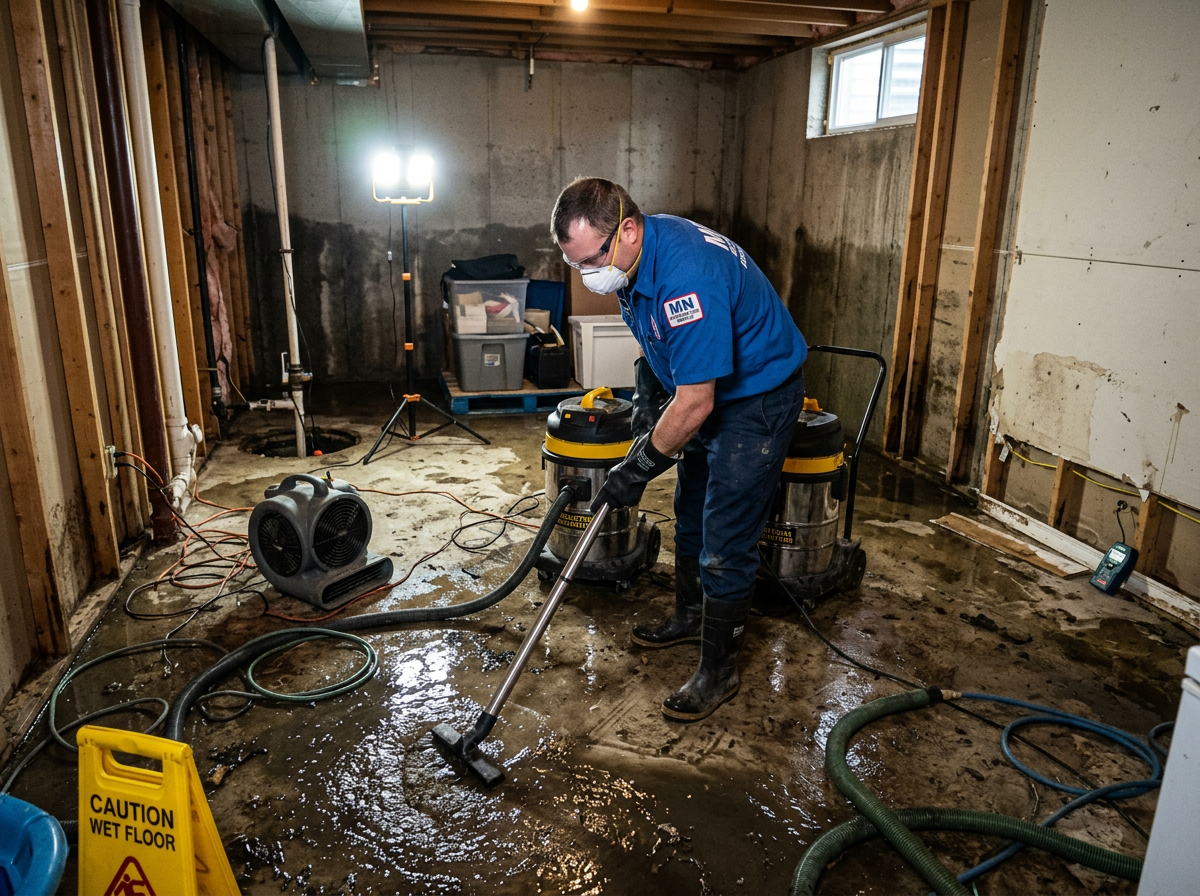
Dayton homes are mostly newer large-lot builds with deep finished basements that sit in heavy clay, so water damage restoration work focuses on fast extraction before finishes are ruined. Long driveways and spring mud affect how equipment reaches each site.
Seasonal patterns are consistent: cold winters give way to rapid thaw that pushes groundwater against foundations, especially near the Mississippi River and along I-94.
Here's how our flooded basement cleanup work runs in Dayton — the same standards we hold across Minnesota, delivered by the crew that covers Hennepin.
Flooded Basement Cleanup Services We Offer in Dayton
✓Spring Snowmelt Seepage Response
Addresses groundwater sheeting over frozen soil that enters foundation cracks and window wells during March and April thaws.
✓Sewer Backup Response
Manages Category 3 water forced upward through floor drains when combined sewers in Minneapolis and Saint Paul surcharge.
✓Sump Pump Failure Response
Handles water accumulation after power loss or mechanical failure during heavy spring rain on the Hennepin lake-belt high water table.
✓Frozen Discharge Line Flooding
Removes water that backs up when sump lines freeze solid or become blocked by ice in sub-zero periods.
✓Finished Basement Restoration
Removes contaminated materials, dries framing, and restores drywall and flooring after any of the three primary flood causes.
✓Contents Pack-Out
Documents, removes, and stores salvageable items from finished basements before demolition and drying begin.
In Twin Cities housing stock, finished basements sit below the 42-to-60-inch frost line, so March and April meltwater sheets across still-frozen ground and enters through foundation cracks or window wells. Older Minneapolis and Saint Paul blocks have combined sewers that surcharge, pushing Category 3 water up floor drains; a missing or failed backwater valve turns the basement into a sewage basin within minutes. Ice dams and frozen sump discharge lines compound the problem when power is lost during spring storms, leaving standing water against finished walls and under carpet pad.
Technicians begin with moisture mapping to locate water that has wicked into drywall, insulation, and subfloor. Extraction uses truck-mounted units sized for the volume, followed by targeted demolition of saturated baseboard and lower drywall to allow drying. In winter conditions, closed windows and high indoor humidity slow evaporation, so dehumidifiers must run longer and air movers are placed to create directed airflow across concrete and framing. Jobs fail when homeowners attempt to dry carpet in place or when hidden cavities behind finished walls are left wet, allowing mold to develop weeks later.
How It Works in Dayton
- 1
On-Site Assessment
Technicians inspect for water source, category, and migration into finished walls and floors at the Osseo address or surrounding Twin Cities location.
- 2
Water Extraction
Standing and trapped water is removed with equipment suited to the volume and contamination level before further wicking occurs.
- 3
Selective Demolition
Saturated drywall, carpet, and insulation are removed to open cavities for drying while protecting unaffected areas.
- 4
Drying and Verification
Air movers and dehumidifiers are positioned for Minnesota winter conditions, followed by moisture meter checks to confirm dry standards.
- 5
Rebuild and Final Clean
New materials are installed and the space is cleaned to pre-loss condition once drying is complete.
Serving All of Dayton
We regularly handle flooded basement cleanup jobs near:
- 📍Dayton City Park
- 📍Mississippi River
- 📍I-94
- 📍MN-101
Flooded Basement Cleanup Pricing in Dayton
Final scope depends on water category, square footage of finished space, and whether sewage or hidden wall cavities are involved. Call for an inspection-based quote.
Want the full picture of this service? See our Flooded Basement Cleanup page, or everything we do in Dayton, MN.